
Three Shifts That Just Changed Workforce Development
Three shifts have collided in 2026 to redefine workforce development: AI in execution, skills-first hiring, and continuous reskilling. Here's why the real problem isn't the skills gap - and what's emerging in its place.
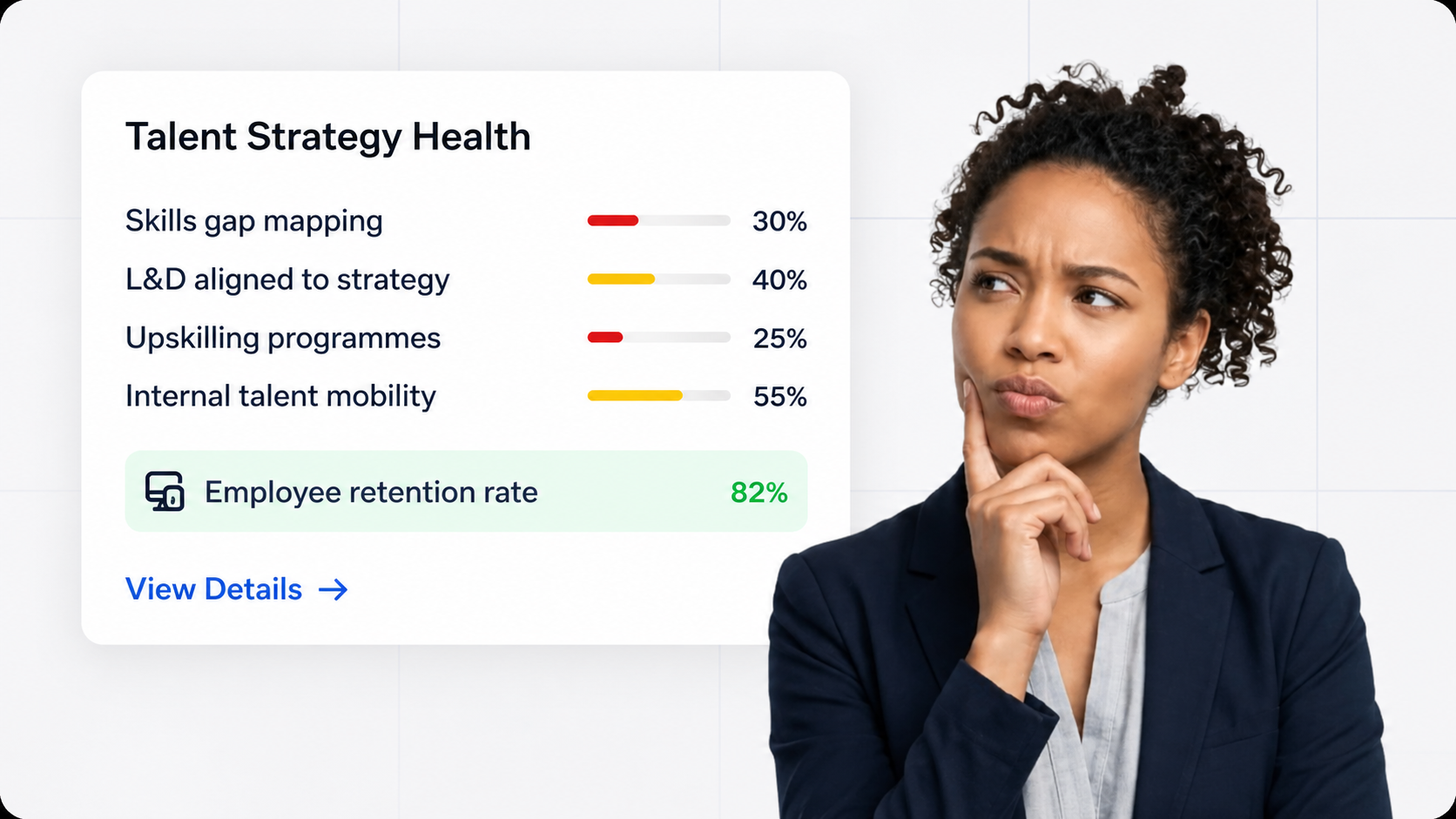


Skills development has always been the foundation of workforce success. That hasn't changed. What's changed is everything around it - how skills are assessed, verified, matched to opportunity, and connected to outcomes.
The conversations coming out of Davos this year pointed to the same underlying shift. Organisations aren't struggling because they lack skills. They're struggling because the systems around skills - hiring, mobility, training, employer engagement - were not designed to work together. The bottleneck isn't skills themselves. It's the infrastructure around them.
The bottleneck isn't skills themselves. It's the infrastructure around them.
What's actually happening in 2026
Three shifts have converged this year, and together they explain why traditional approaches to workforce development are reaching their limits.
AI has moved from experimentation to execution. Most enterprises now have access to AI tools. What they lack is the operating model to use them well. Gartner reports that only one in 50 AI investments delivers transformational value. The technology is not the limiting factor. The way work is structured around it is.
Skills-first hiring has hit the mainstream. As of April 2026, 81% of major employers have integrated skills-based assessment into hiring. The resume is no longer the gold standard. Employers want verified capability, not credentials that may or may not reflect what someone can actually do.
Continuous reskilling has become a business discipline. The World Economic Forum estimates that 1.1 billion jobs will be transformed by technology over the next decade. Reskilling is no longer a periodic initiative. It is a constant function of how organisations operate.
Together, these shifts expose the same underlying problem: most workforce systems were never designed to operate this way.
Why the system hasn't kept up
For most of the last thirty years, workforce development has followed a predictable pattern. Universities produce graduates. Training providers fill skills gaps. Employers hire on credentials. Career services support the transition. Each function works in isolation, with handoffs that are mostly manual and largely opaque.
This was adequate when jobs were stable, skills were durable, and credentials were a reasonable proxy for capability. That is no longer the case.
Roles are being reshaped continuously. Skills are depreciating faster than traditional models can refresh them. Credentials tell employers less and less about what someone can actually do. And AI is now embedded in nearly every workflow, which means workforce development must account for capability that did not exist eighteen months ago.
The result is a structural mismatch between how workforce systems are built and what they are now expected to deliver. It is the reason AI pilots underperform, skilling investments fail to convert to employment, and skills-first hiring remains a slogan rather than an operating principle in many organisations.
What needs to change
Three things stand out across the partnerships we work in.
Skills need to weighted as heavily as grades. When skills are structured, assessed continuously, and shared across systems, they become the connective tissue between learning, hiring, and career mobility. This is the condition skills-first hiring requires to operate at scale.
AI needs to run through the system, not sit alongside it.AI is already embedded in how most roles are performed, how skills are assessed, how learners are matched to opportunity, and how programmes are evaluated. The institutions getting it right are not running AI as a side initiative. They are treating it as a layer that runs through curriculum design, skills profiling, employer engagement, and outcomes reporting.
Workforce development needs to be designed as a system, not delivered as a series of programmes. Standalone training programmes - however well designed - struggle to produce employment outcomes when the rest of the ecosystem is disconnected. The strongest results in 2026 are coming from institutions that have stopped treating strategy, training, technology, and employer engagement as separate workstreams. They have built the connective infrastructure that lets each function inform the others.
What this looks like in practice
We have spent the last few years building this connective layer with universities, governments, and enterprises across Asia-Pacific and the Middle East.
A top-ranked Singapore university has run cohort-based career transition programmes with us since 2020, training over 1,200 mid-career professionals with completion rates above 95% and an NPS of +64. The curriculum is mapped to real job roles. The instructors are practitioners. AI is now embedded across every domain as a layer woven into how each programme prepares learners for current employer demand.
A national skills fund in the Middle East has delivered five tracks of digital upskilling to 500 nationals through our managed delivery model, with an average NPS of +62. Curriculum, instructors, platform, and operations - running as one connected system rather than four separate contracts.
The pattern across these partnerships is consistent. When the parts of workforce development connect, the outcomes change.
The shift that defines 2026
The institutions that will define workforce development in this decade are not the ones investing most heavily in AI tools or running the most programmes. They are the ones rebuilding the underlying system - so skills, training, employer demand, and outcomes operate as one connected ecosystem.
The skills gap was always a symptom. The AI gap is a symptom too. The substantive work is redesigning the system itself.
That work is already underway. Universities are reshaping how career services connect to employers. Governments are translating national skills investment into measurable employment outcomes. Enterprises are moving from job descriptions to skills-based workforce planning.
The institutions that close the infrastructure gap will define how the next decade of work unfolds.


Relevant Articles



Workforce Outcomes, Delivered at Scale.
If you are building the future of workforce development and need a partner who can deliver measurable impact, let’s talk.
Start a conversation about your goals
Get in touch by booking a call or filling out the form.


